PCB prepreg and PCB core are two of the most important materials in PCB manufacturing. They define the structure of the board, affect the electrical performance, and ensure PCB durability. However, some newcomers in PCB design still feel confused about these two materials: Are they the same thing? Can they be used interchangeably? The answer is absolutely NO. In this article, we will explain what they are and explore PCB prepreg vs core in detail.
What Is PCB Prepreg?
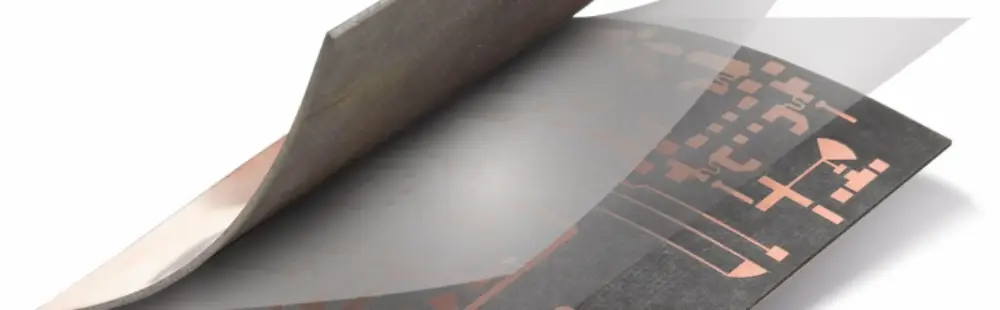
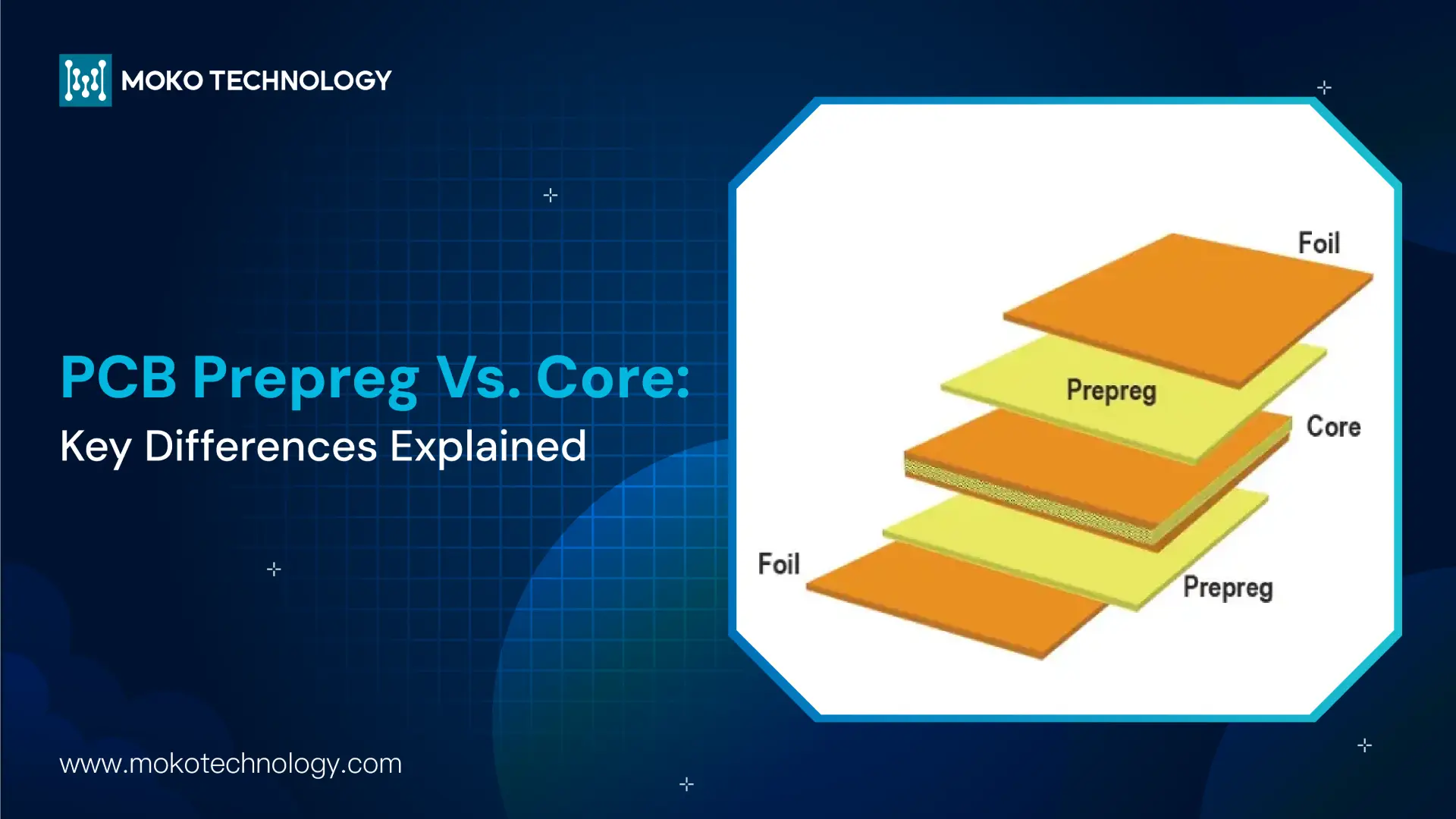
PCB prepreg is a partially cured fiberglass cloth that is pre-impregnated with resin, acting as an insulating and bonding layer for multilayer PCBs. It’s placed between copper foil and cores to provide electrical insulation and structural strength. Imagine it’s a hamburger, the prepreg is the cheese between the bread and ham. Under heat and pressure, the resin would flow and then harden to bond layers together. More importantly, the prepreg can also be customized to change the chemical properties to achieve the selective conductivity. It means that some areas would be conductive while other areas would keep insulating. Meanwhile, the resin content and fiber-woven direction of the prepreg decide the mechanical and electrical performance, making them critical for reliable PCB manufacturing and design.
Common Prepreg Types and Their Typical Properties
| Prepreg Type | Thickness After Lamination (mm) | Typical Resin Content | Typical Applications |
| 1080 | 0.065–0.085 mm | High (≈65–68%) | HDI boards, thin dielectric spacing, controlled impedance, high-speed layers |
| 2116 | 0.115–0.155 mm | Medium (≈55–60%) | Standard multilayer PCB stack-ups |
| 7628 | 0.17–0.20 mm | Low (≈40–45%) | Power boards, structural reinforcement, thicker dielectric requirements |
What Is PCB Core?
PCB core is a fully cured fiberglass-epoxy laminate, usually made from FR4, with copper foil covered on both sides. It works as the rigid base for printed circuit board that provides mechanical strength, flatness, and size stability. Unlike prepreg that is partially cured and flowable, the core is tough, stable, and does not deform during lamination. In multilayer PCB, the core as the inner layer carry copper traces and power planes, and the prepreg is used to bond them together. Depending on the performance requirements, the core can also be made from polyimide for high-temperature resistance or high-frequency laminates like Rogers for RF applications.
Common PCB Core Types and Their Properties
| Core Type | Typical Thickness (mm) | Material Options | Dielectric Properties | Typical Applications |
| FR4 Core | 0.1 / 0.2 / 0.4 / 0.8 / 1.0 / 1.6 | Standard FR4 / High-Tg (Tg170–180) | Dk ≈ 4.2–4.7 / Df ≈ 0.015–0.020 | General multilayer PCBs, most consumer electronics |
| Polyimide Core | 0.1–0.8 | Polyimide laminate | High-temp, low CTE | Automotive, industrial, aerospace |
| High-Speed Core | 0.1–0.5 | Megtron 6 / Isola I-Speed / Tachyon 100G | Low Dk (3.2–3.7), Low Df (≤0.005) | High-speed digital (PCIe, DDR4/DDR5), networking |
| RF/Microwave Core | 0.13–3.2 | Rogers 4350B / 4003C / Taconic / PTFE | Dk 2.2–3.5, ultra-low Df | RF front-end, antenna, communication boards |
| Metal-Core (MCPCB) | 1.0–3.2 (Aluminum or Copper) | Aluminum / Copper substrate | Good thermal conductivity | LED, power electronics, motor drivers |
How PCB Prepreg and Core Work Together in a PCB Stack-Up
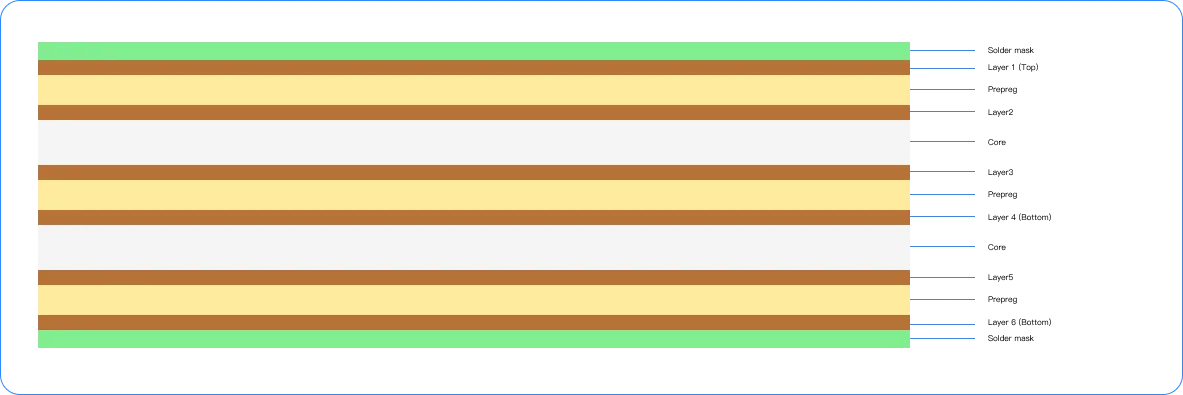
In a multilayer PCB, the prepreg and core are laminated to form a single and solid board. In the process, the prepreg softens and bonds to the copper layers and cores, creating good bonding and insulation. When the stack is pressed and heated (~180 °C), the resin in the prepreg flows and cures, creating a unified structure. Upon cooling, a rigid board is obtained that has precise dielectric spacing and strong interlayer bond.
Example of a 6-layer PCB stack-up:
Prepreg Vs. Core: What Are the Differences?
Here is a quick glance at the differences between PCB prepreg and PCB core:
| Aspect | PCB Prepreg | PCB Core |
| Material Composition | Fiberglass cloth with partially cured resin | Fiberglass laminate with fully cured resin |
| Function | Bonds and insulates layers during lamination | Provides structural support and copper layers |
| Curing Stage | Softens and hardens during lamination | Already fully cured and rigid |
Key Differences between PCB Prepreg and Core:
- Curing Stage
One of the key differences between PCB prepreg and PCB core is the curing process. The core is fully cured and hard, while PCB prepreg is semi-cured. This difference determines how each material behaves during manufacturing.
- Function in PCB Construction
The core works as the structural foundation of the boards, which provides strength, mechanical support, and internal copper layers for signal routing. Prepreg, on the other hand, functions as an adhesive and insulating layer between cores and copper foils. It ensures strong bonding and electrical isolation between layers.
- Flexibility and Customization
Because the core is already cured, its electrical and mechanical properties are fixed. Prepreg is more adaptable—its resin type, resin content, and glass weave can be adjusted to fine-tune the board’s dielectric constant, thickness, and resin flow.
Although prepreg and core have different functions and are placed in different positions in the PCB stack-up, they share common material properties and functions, operating together to provide the board with structural integrity and stable performance:
- Both PCB prepreg and core are made from fiberglass reinforced with resin such as FR4, polyimide, or other high-Tg materials.
- Both materials affect a board’s dielectric properties, influencing signal integrity and impedance control. Their dielectric constant (Dk) and dissipation factor (Df) must be carefully matched to ensure consistent electrical performance across all layers of the PCB.
Conclusion
In summary, when examining PCB prepreg vs core, both are essential parts used to build a circuit board, working together to form a functional and reliable PCB. The core plays the role of the PCB’s foundation, and the prepreg bonds and insulates the layers during lamination. Selecting the right combination ensures the PCB performs reliably under electrical, thermal, and mechanical stress.
At MOKO Technology. we use high-quality prepregs and cores to produce robust multilayer PCBs that meet international standards like IPC-6012 and ISO 9001. Whether you need standard prototypes or high-speed designs, our engineering team can help you choose the best materials for your project.
FAQs About PCB Prepreg and Core
- What is the difference between core and prepreg in PCB?
PCB prepreg is a semi-cured fiberglass material used to bond and insulate layers during lamination, while the PCB core is a fully cured laminate with copper on both sides that provides mechanical strength and forms the internal circuit layers.
- What is the purpose of prepreg in PCB?
Prepreg fills the gaps between copper layers, creates insulation, provides bonding during lamination, and controls the dielectric spacing needed for impedance and signal integrity.
- How do I choose the right prepreg for my PCB?
It depends on impedance, thickness requirements, resin content, and signal type. Thin prepregs (1080) are used for HDI or high-speed layers; thicker prepregs (7628) suit power boards.