When building or testing electronic circuits, engineers either use a protoboard or a breadboard. However, choosing between protoboard and breadboard can be confusing, especially for beginners. When deciding between a protoboard and a breadboard, there are a few key factors to consider. The choice affects circuit stability, debugging efficiency, and whether your design can move toward production. Read on to find out.
What Is a Protoboard?
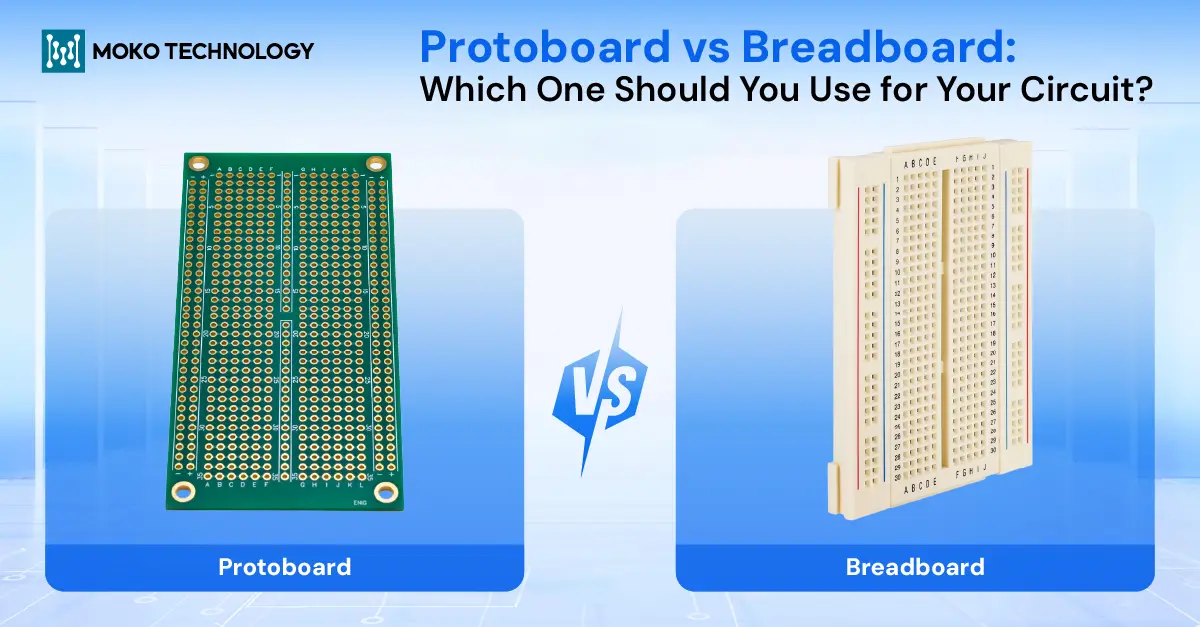
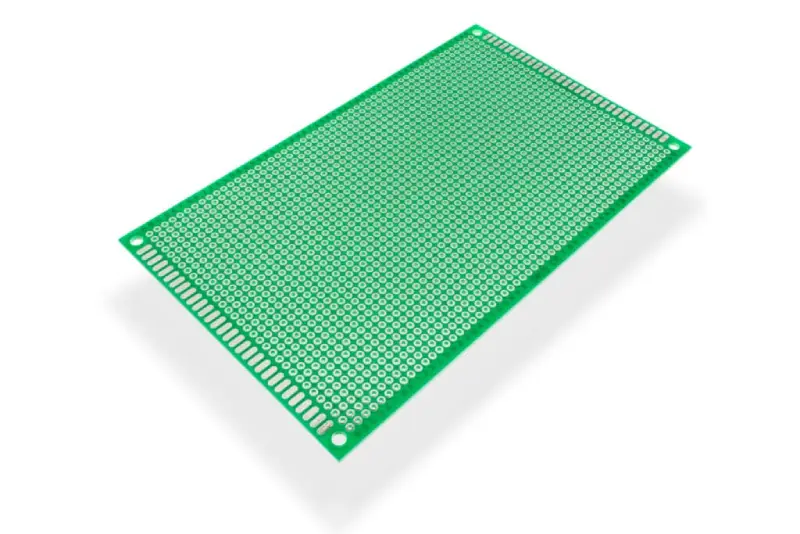
A protoboard (also called a prototyping board) is a board used to build and test out electronic circuits. It consists of a flat insulated surface with holes, solder pads, or sockets to insert components. The pads/holes are interconnected with copper traces in a pattern underneath the board.
 Advantages of Protoboard
- Stable and durable connections – Soldering components to the protoboard creates robust mechanical and electrical connections that can withstand stress and last a long time.
- Good for permanent projects – If your circuit design is unlikely to change much, a protoboard creates a semi-permanent solution perfect for the final project build.
- Customizable layouts – Protoboards allow flexibility in component placement and routing of traces. You can optimize the layout for your specific design needs.
- Handles complexity well – The stability of a protoboard is ideal for building more intricate, complex circuit designs reliably.
- Cost-effective – Protoboards offer an affordable option for hobbyists and students compared to custom PCB fabrication.
Disadvantages of Protoboard
- Requires soldering skills – To assemble circuits on a protoboard you’ll need to know how to solder components correctly and cleanly.
- Less reusable – It’s not as easy to remove/replace components on a protoboard compared to using a breadboard or stripboard.
- Limited debugging – Troubleshooting malfunctions can be tricky since you can’t just plug and unplug connections to test. May require desoldering.
- Lower speed – Not well suited for very high frequency PCB or RF circuits. The traces have more impedance than a PCB.
What Is a Breadboard?
A PCB breadboard is also known as the solderless board, which is a construction base for temporary circuits, used for prototyping, testing, and experimenting with different electronics designs. The standard breadboard contains a grid of holes connected underneath by metal clips. The clips form horizontal rows and vertical columns of connected points. This allows you to insert component leads and wires to connect them up without any soldering.
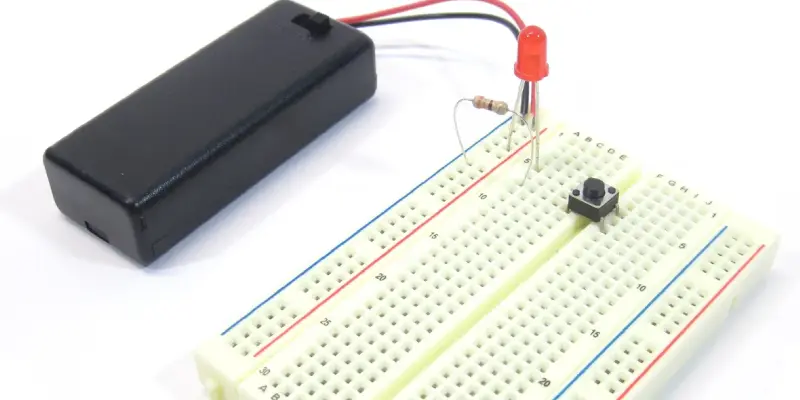
Advantages of Breadboard
- Solderless – No soldering is required, just push components and wires into the holes to connect them. Very beginner friendly.
- Reusable – Components can be removed and rearranged easily to modify the circuit. Great for experimenting.
- Rapid Prototyping – Allows quick testing of circuit ideas by assembling temporary connections.
- Visual Feedback – The layout provides a clear visualization of the circuit connections. Easy to troubleshoot.
- Inexpensive – Breadboards are very affordable compared to other prototyping options.
Disadvantages of Breadboard
- Less Stable – The spring clip connections can loosen over time leading to faulty contacts in complex circuits.
- Not Permanent – Breadboard circuits are only meant to be temporary and can’t be made into permanent projects.
- Messy Wiring – Lots of jumper wires crossing over each other can make the layout confusing visually.
- Size Limitations – Large or highly complex circuits may not physically fit on a breadboard.
- No Mounting – Since breadboards are not soldered, they can’t be securely mounted into enclosures.
Protoboard vs Breadboard: Key Differences at a Glance
| Feature | Protoboard | Breadboard |
| Connection Method | Components are soldered to copper pads or traces | Components plug into spring-loaded metal clips |
| Soldering Required | Yes | No |
| Primary Purpose | Semi-permanent or long-term circuit builds | Temporary prototyping and experimentation |
| Ease of Modification | Low – requires desoldering | High – easy plug-and-play changes |
| Connection Stability | Stable and reliable | Contacts can loosen over time |
| Best For | Finalized prototypes, extended testing, complex circuits | Early-stage testing, learning, rapid iteration |
| Circuit Complexity | Handles complex and dense circuits well | Best for simple to moderately complex circuits |
| Debugging Speed | Slower due to fixed soldered connections | Fast and intuitive |
| Durability | High; suitable for long-term use | Low; not intended for permanent projects |
| High-Frequency Performance | Better than breadboards but limited vs PCBs | Poor for high-frequency or noise-sensitive circuits |
| Cost Consideration | Higher initial cost, reusable | Low cost, disposable |
Protoboard vs Breadboard: 5 Key Differences Explained
- Connection type
Protoboards have copper traces etched on the substrate that components are soldered or pressed into. The soldering forms durable mechanical and electrical bonds, but makes altering connections more difficult.
Breadboards utilize removable spring clips underneath the board to hold wires and components in place. Simply inserting leads into the holes creates temporary connections between components without soldering. This allows quick changes to be made for prototyping new designs.
- Reconfigurability
Protoboard changes require desoldering and resoldering components, making modifications slower and more difficult. In contrast, breadboards enable easy component insertion/removal to reconfigure circuits by plugging/unplugging. This modifiability aids iterative design processes and experimentation.
- LayoutFlexibility
Breadboards have predefined internal connection patterns that can limit complex multi-component circuit designs. Protoboards offer custom layouts tailored specifically for a circuit’s needs by cutting traces and positioning components. This aids complex circuit implementation.
- Durability
PCB breadboard spring clip connections gradually loosen with repeated insertion/removal when prototyping changes. This makes them less suited for long-term use. Protoboard soldered connections withstand stress and remain robust over time and repeated circuit use.
- CostConsiderations
Breadboards are inexpensive, making them cost-effective disposable prototyping options. Protoboards have higher initial costs but can be reused for multiple projects, making them better for permanent circuits.
Protoboard vs Breadboard: Which One Should You Choose?
The decision between a breadboard and a protoboard depends on the maturity of your circuit design and the level of reliability required at each development stage.
Use a breadboard for:
- Early-Stage Experimentation
Breadboards are easy to assemble without soldering, which makes them the best fit when it comes to validating a concept and trying out design alternatives.
- Frequent Design Changes
Breadboard components and connections are easily added, removed or rearranged and this makes debugging and iteration quite quick.
- Functional Validation
Breadboards are very useful in checking simple circuit logic and signal route where temporary connections are acceptable.
- Learning and Prototyping Speed
Breadboards would offer the shortest route between a concept and a working circuit in the situation where long-term stability is not very crucial, whereas speed and flexibility are.
Use a protoboard for:
- Design Stabilization
After checking the behavior of the circuit on a breadboard, protoboard connections can be soldered to provide more reliable electric performance. - Improved Mechanical Reliability
Protoboards are more resistant to handling and movement when compared to breadboards, and the probability of intermittent connections is minimized. - Semi-Permanent Prototypes
They can be used for demonstrations, long-lasting tests, or just one-off constructions that are required to be operational in the long run. - Pre-PCB Validation
Protoboarding aids in discovering problems in layout and assembly construction before committing to a custom PCB.
From Breadboard to Protoboard: A Typical Prototyping Workflow
During the electronics development process, both breadboard and protoboard are needed.
First, engineers would use a breadboard to test the basic function and logic of the circuit. And if there is any design changes, they can quickly make modification or iteration on the breadboards according to the changing requirements.
Once verified the circuit and finished the schematic, engineers would move on to a protoboard. Protoboards provide more reliable electrical connections and have better mechanical stability than breadboard. Using this kind of board can help to detect issues in layout, soldering, or signal stability that might not be found during the breadboard testing stages.
This is the standard prototyping workflow, moving from breadboard to protoboard, and then to mass production of PCB. However, for some simple PCB designs, engineers may skip one step to speed up delivery time.
Final Thoughts
When deciding between a breadboard vs protoboard, it’s important to understand that both have their advantages and are extremely useful tools for electronics prototyping. Breadboards provide a quick, convenient, and budget-friendly way to test out circuit ideas. But protoboards offer more robustness, organization, and precision for complex or long-term projects. Whichever you choose, keep in mind your specific needs in terms of permanence, complexity, replicability, cost, and rearrangeability. With the right prototyping board selected for your application, you’ll be equipped to efficiently turn your innovative circuit ideas into functioning realities.
FAQs
What’s the key difference between protoboard and breadboard?
The major difference between a protoboard and a breadboard is the connection method. Protoboards use soldered connections, while breadboards use spring clips for temporary connections.
Protoboard vs breadboard: Which one is more suitable for temporary circuits?
Bread board is more suitable for temporary circuits as it can be assembled quickly and no soldering is required to make any modification.
What are the advantages of using protoboard?
A protoboard offers stable and reliable connections, making it suitable for semi-permanent circuits, complex layouts, and projects that require consistent electrical performance.
Can a protoboard be reused?
Yes, you can use protoboards repeatedly, but the number of reuses is limited. When reusing protoboards, desoldering is required, and this may damage the solder pads or traces.