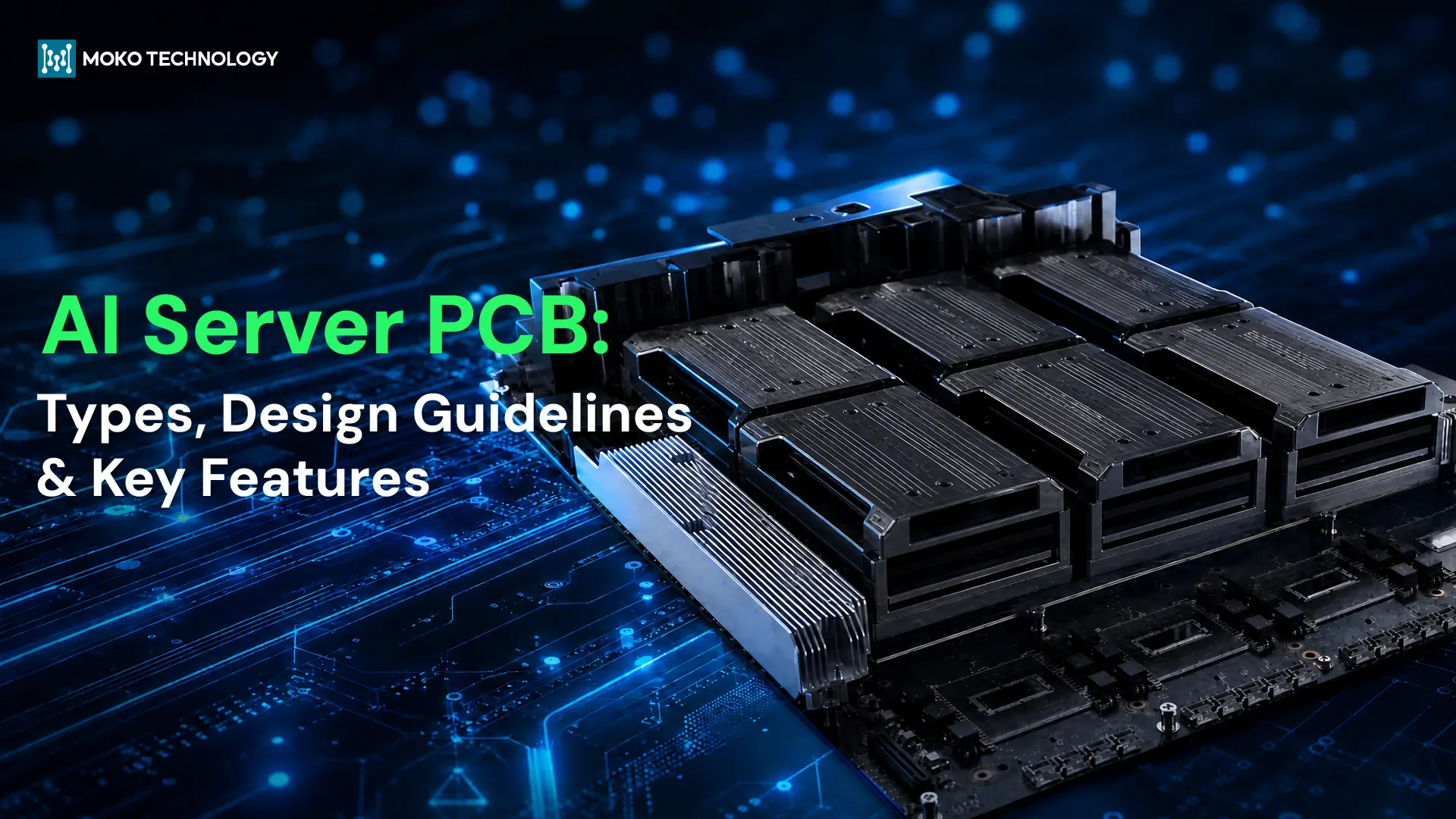
The rapid growth of artificial intelligence has driven significant demand for the hardware that supports it, including AI server PCBs. As AI workloads continue to rise, servers need to process greater amounts of data, and support more capable accelerators and faster data transmission. Therefore, AI server PCB must be designed and manufactured to meet these demanding requirements. This article delves into the features of AI server PCBs, the different types of PCBs used in AI computing systems, and essential AI server PCB design guidelines.
What Is an AI Server PCB?
An AI server PCB is a printed circuit board specifically designed to support the high-performance computing requirements of artificial intelligence workloads. It serves as the foundation for connecting and powering critical components such as GPUs, CPUs, high-bandwidth memory (HBM), networking devices, and power delivery systems. Compared to conventional server boards, AI server PCBs need more complex routing structures, stronger thermal and power control abilities, advanced materials and higher layer counts.
AI Server PCB vs Standard Server PCB: Key Differences
Though AI servers have similar system architectures to standard servers, they have much higher requirements for the PCBs used than standard ones. AI server PCB boards are more precise and complex, more capable of handling data, and, of course, more expensive than standard server PCBs.
The table below compares the key differences between the AI server PCB and the standard server PCB:
| Feature | Standard Server PCB | AI Server PCB |
| Layer Count | Typically 8-24 layers | Commonly 28–46 layers |
| Board Thickness | 2mm-5mm | 4mm-5mm |
| Aspect Ratio | Up to 15:1 | Up to 20:1 |
| Data Rate | PCIe 4.0 (16 GT/s) | PCIe 5.0/6.0, 112G/224G networking |
| Materials | Standard FR4 or mid-loss materials | Low-loss and very low-loss materials |
| Power Density | Moderate | Extremely high |
| Thermal Requirements | Conventional cooling solutions | Advanced thermal management |
| PCB Complexity | Medium | Very high |
7 Main PCB Types Found in AI Servers
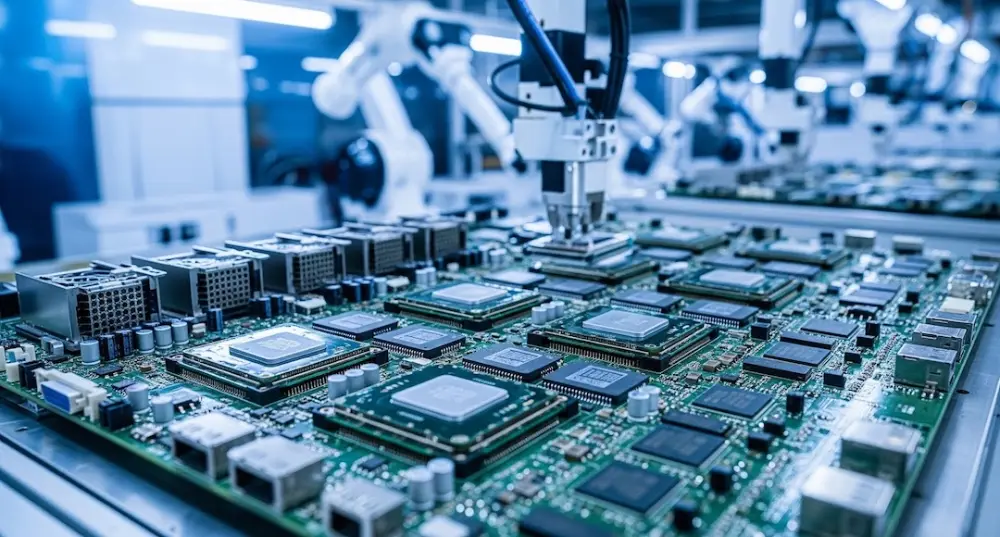
An AI server typically contains several kinds of PCBs, each performing specific functions to enable computing, communication, storage, power delivery, and system management. Here are the 7 main PCB types found in AI servers:
1. GPU Baseboard (Unit Baseboard / UBB)
The GPU baseboard plays a role as a platform to mount GPU modules, route high-speed NVLink connections, and provide PCIe host interfaces. Typically these type of PCBs are comprised of ultra-low loss laminates like Megtron 7, with 24-32 layers, and they also demand strict impedance control in order to meet the extreme signal integrity requirements for 112G/224G PAM4 AI workloads.
2. GPU Accelerator Module PCB (OAM/SXM)
This board integrates the GPU package, HBM memory stacks, and onboard power management (VRMs). The module PCB requires an ultra dense, 16–20 layer HDI construction with an ultra fine trace width and spacing.
3. Server Motherboard (CPU Host Board)
The server motherboard used in AI server is the central hub that connects the host CPUs, system memory, PCIe interfaces, and the BMC. This kind of PCB is usually constructed with 16 layers to 24 layers, and it needs to provide strong signal integrity in the case of high density DDR5 memory channels and high-speed PCIe Gen5/Gen6 buses.
4. Power Board / PSU PCB
These boards are used to handle AC-DC conversion and provide power across a high-efficiency 48V Power Delivery Network (PDN). They feature thick layer copper (typically 2–3 oz or higher), high-voltage isolation, and good thermal management to reliably deliver thousands of watts to the processor array.
5. NVSwitch Board (Fabric Tray)
NVSwitch boards are used to manage full-mesh, GPU-to-GPU NVLink routing in rack-scale systems. They are characterized by extremely high layer counts, usually from 32 layers to 40 layers or even more. Made with Any-Layer HDI / ELIC construction and premium ultra-low-loss materials, they can maintain signal quality across massive, dense interconnect fabrics.
6. Network Interface Card (NIC / DPU)
This is used to support ultra-high-speed cluster networking based on ConnectX or BlueField architectures. These circuit boards are designed for PCIe Gen5/Gen6 interfaces and 400G to 800G data transfer, which enable AI servers to send and receive large amounts of data at rapid speeds.
7. Management Board (BMC)
Compared to other AI server PCBs, the management board has a lower layer count, typically 6–10 layers, and most of them are made from standard FR4 materials. However, it enables administrators to monitor hardware health, power metrics, and thermals independently of the main CPU, as it provides out-of-band server management functions.
Key Features of AI Server PCBs
AI server PCBs are built to meet a range of demanding technical requirements. Below are the key features that distinguish them from standard server boards:
- High Layer Counts
AI server PCBs have more layers than standard server PCBs, since they need to support higher routing density, handle more complex power distribution networks, and enable faster data transmission. Multilayer construction is essential for supporting these requirements.
- High-Speed Signal Transmission
AI servers need to transfer huge amounts of data between CPUs, GPUs, memory, and network devices. Therefore, AI server PCBs must support high-speed signal transmission to ensure fast and reliable system performance.
- Low-Loss Materials
As data increase, insertion loss becomes a greater concern. Therefore, AI server PCBs are usually made from low-loss materials such as Megtron 6, Megtron 7, Tachyon 100G, and other ultra-low-loss laminates.
- High Power Delivery Requirements
AI accelerators consume substantially more power than traditional server components; hence, AI server PCBs are usually made with robust power delivery capabilities to support stable and efficient system operation.
- Advanced Thermal Management
AI server PCBs feature advanced thermal management. To achieve optimal heat dissipation, these circuit boards are designed with thermal vias, extensive copper planes, and optimized component placement.
- HDI Structures
Many AI server applications require HDI technologies to support fine-pitch packages and dense routing requirements. Microvias, blind vias, buried vias, and sequential lamination techniques are commonly used to achieve the routing density required by modern GPU and accelerator designs.
Further reading: Blind Via & Buried Via: What’s the Difference?
AI Server PCB Design Guidelines
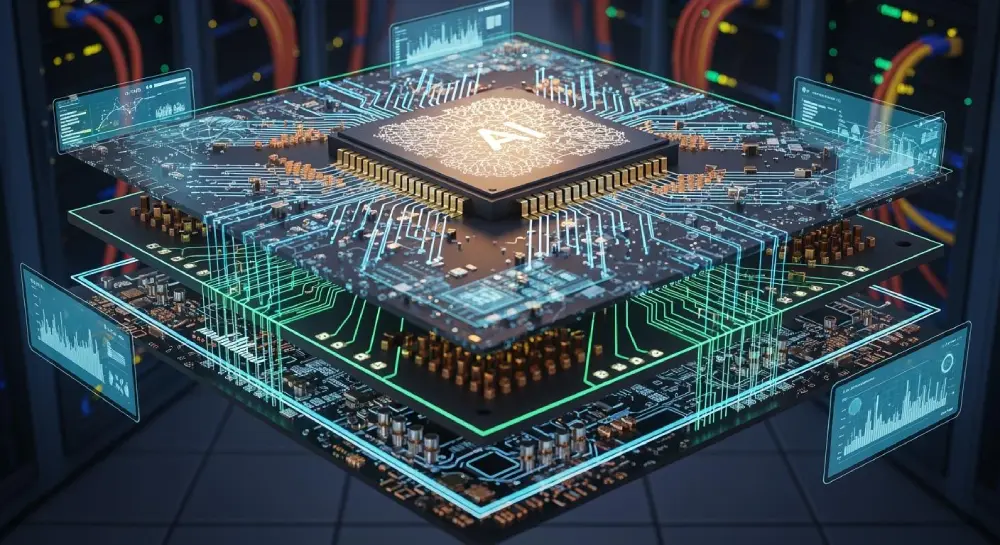
Designing AI server PCBs is far more complex than designing conventional server boards. Several key design principles must be considered throughout the development process.
Plan the Stack-Up Early
AI server PCBs are equipped with numerous high-speed interfaces and a complicated power distribution system, therefore, stack-up planning should start early in the design phase. High-speed signals should be positioned in inner layers; maintain a balanced layer structure and arrange power and ground planes strategically to enhance signal quality and reduce interference.
Optimize High-Speed Routing
Careful routing of PCIe, DDR memory and high-speed networking channels is necessary. To maintain the best signal quality throughout the system, PCB designers must consider the aspects of controlled impedance, length matching, crosstalk reduction, and more.
Build a Low-Impedance Power Distribution Network
The power demands of GPUs and AI accelerators are ever-growing, making power integrity a key design concern. To achieve this goal, optimized power planes, proper decoupling capacitor placement, and efficient current paths are necessary during the AI server PCB design process.
Optimize Thermal Management
Another critical factor to consider when designing AI server PCBs is the heat generated by high-performance GPUs and AI accelerators. Thermal vias, copper planes, and component placement can be used to improve heat dissipation and reduce thermal hot spots.
Use HDI Technologies
Modern AI server PCBs usually use high-pin-count devices and advanced packages, making dense routing necessary. To improve routing efficiency, HDI technologies such as microvias, blind vias, buried vias, and sequential lamination are often used to support more complex PCB designs.
Minimize Via Stub Effects
To maintain reliable high-speed data transmission in AI server applications, it’s important to reduce the via stub length. Techniques such as backdrilling and optimized via structures are commonly used for this purpose.
Design for Reliability
AI server platforms are expected to operate continuously for extended periods. Material selection, thermal design, and manufacturing quality should all support long-term reliability and stable operation.
MOKO Technology’s AI Server PCB Capabilities
When choosing AI server PCB manufacturers, it’s critical to make sure you find one that is professional, experienced, and capable. MOKO Technology, with 20 years of experience in the PCB industry, provides PCB fabrication and PCB assembly services for advanced computing and AI server applications. Our capabilities include:
- High-layer-count PCB manufacturingup to 40 layers, supporting complex multilayer routing for AI server architectures
- HDI PCBfabrication with precisely laser-drilled microvias
- Low-loss material processingfor high-frequency, high-speed signal integrity
- Controlled impedance productionverified by TDR testing
- BGA assemblywith more than 1000 solder joints
- Comprehensive quality assurance including AOI, 3D AXI X-ray inspection, ICT, and functional testing
Whether it’s a prototype or high-volume manufacturing, MOKO Technology provides end-to-end PCB solutions engineered for the performance, reliability, and signal integrity requirements of AI server applications. Contact us today to get a free quote.
FAQs about AI Server PCB
1.What is an AI server PCB?
An AI server PCB is a printed circuit board that is specially designed for AI servers. Compared to standard server PCB, it supports higher computing power, faster data transmission, and greater power consumption.
2. How many layers does an AI server PCB typically have?
Typically, AI server PCBs have layer counts ranging from 28 to 40 layers. However, more sophisticated designs may require even higher layer counts.
3. Why do AI server PCBs require low-loss materials?
Low-loss materials can reduce signal attenuation and maintain signal integrity, which is essential for AI server PCBs because they need to support high-speed interfaces such as PCIe 5.0, PCIe 6.0, and advanced networking technologies.
4. What are the main challenges in AI server PCB design?
The key challenges include signal integrity, power integrity, thermal management, routing density, reliability, and ever-increasing data transmission speeds.
5. What manufacturing technologies are commonly used in AI server PCBs?
During the process of AI server PCB fabrication, technologies like HDI fabrication, sequential lamination, backdrilling and controlled impedance manufacturing are commonly used.